

The Stabilizing Backpack Project
In the spring semester of 2022, my BIOE Design and Prototyping II class gave us a client to work with throughout the semester. This client told us of a problem they had, which related to a backpack. So, a team of 5 members including me started working towards coming up with a solution.


The Problem / Request

As stated before, the client wanted us to help them with their backpack. In particular, they are affected by Cerebral Palsy, specifically, hemiplegia which affects the right side of their body.
"Hemiplegia, paralysis of the muscles of the lower face, arm, and leg on one side of the body."
Because of this condition, they have had difficulty using regular backpacks of different kinds. The problems with other backpacks had to do with the action of putting it on and off regularly, the backpack straps sliding off their shoulders, with a single strap backpack it was uncomfortable to have all the weight on one shoulder, with rolling backpacks it was difficult to drag it around, and there was general difficulty with parts of the backpack such as the zippers. The main problem that we tried to focus on had to do with the client's balance. Regular backpacks that they had tried before were particularly troublesome around things such as stairs.
Besides the hemiplegia affecting the client, some areas are more affected than others. One of the more affected parts of the body is the client's right foot and right shoulder.
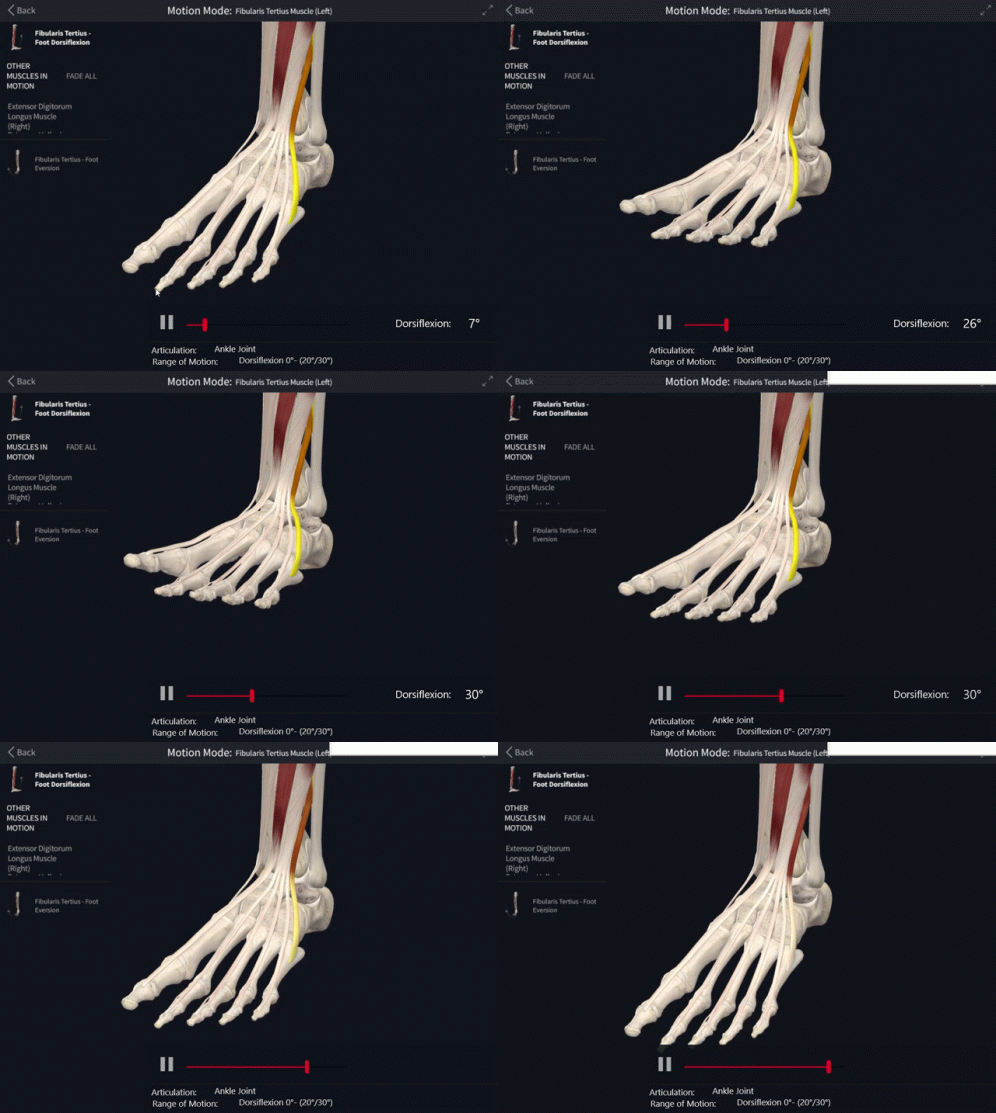
For the right foot, the client has essentially zero ability for dorsiflexion.
"Dorsiflexion, flexion of the foot in an upward direction."
The main problem that the team observed when talking to the client was that this inability to flex the foot, plus changes in walking gait/patterns caused the client to have imbalance while walking, especially and most pronounced while walking up and downstairs. This and the internal shifting and moving of the contents the client's backpack holds would cause difficulty balancing.
For the right shoulder, the client could not put their arm up above their head very much.
The Solution / Design Idea
My team and I came up with a few ideas to address all of the issues the client had with backpacks. Some of the easier solutions we came up with were things such as a backpack where the main opening was just a bag that folded over without zippers, the things that needed to be secured or fastened would use magnetic buckles which require little to no fine motor function of the hands.


*These images are examples and not the actual design for this project.
The aspect and idea that we chose to focus on the most was the balance of the client through what we used to call the "gyroscopic backpack", now more clearly called the "stabilizing I-frame". This idea came about when ideating for the design in the beginning stages of the process. I thought about a plane's "Attitude indicator".
"Attitude indicator, formerly known as the gyro horizon or artificial horizon, is a flight instrument that informs the pilot of the aircraft orientation relative to Earth's horizon and gives an immediate indication of the smallest orientation change. The miniature aircraft and horizon bar mimics the relationship of the aircraft relative to the actual horizon."
In short, the idea was to keep the backpack stationary and independent from the wearer's movements. It consists of two frames, one for the straps the user would wear and one for the backpack to be set upon, which are set on an axis. There were 3 iterations of the frame design, all made of the same material, PLA plastic.


The first frame was really just testing out the dimension and getting an idea of how the device worked.
The second frame was us trying to reduce the weight of the frames and figure out a way to make the frame into pieces that could attach to each other. This problem came up when we were going to start 3D printing the parts for the frame, but the 3D printer was not big enough to print the entire thing as one piece.
The third frame was us thinking about a massive reduction of weight and maintaining only what is necessary. This ended up causing the I-frame shape.
The final product ended up looking how we hoped, however the functionality of it still could use some work to finalize the design.